ARTICLE TEMPLATE


Open Access Policy
Foremost Journal provides immediate open access to its content on the principle that making research freely available to the public supports a greater global exchange of knowledge. All articles published by Foremost Journal are available worldwide under an open-access license which means everyone has free and unlimited access to the full-text of all articles published in Foremost Journal, and everyone is free to re-use the published material if proper accreditation/citation of the original publication is given.
Focus and Scope of the Journal
FOREMOST Journal invites scholars, researchers, and students to contribute the result of their studies and researches in English with scopes language education, applied linguistics (including sociolinguistics, psycholinguistics, and neurolinguistics) in language education, cultural studies & cultural education, intercultural education, Translation studies and education, and research methods in related fields.
History of the Journal
This scientific journal is published by English Language Education Department, Faculty of Teacher Training and Education, the Islamic University of Syekh-Yusuf Tangerang since January 2020. It publishes two issues in a year (February and August)
Privacy Statement
The names and email addresses entered in this journal site will be used exclusively for the stated purposes of this journal and will not be made available for any other purpose or to any other party.
Archiving
This journal utilizes the LOCKSS system to create a distributed archiving system among participating libraries and permits those libraries to create permanent archives of the journal for purposes of preservation and restoration. More...
Papers submitted to Foremost Journal will be screened for plagiarism using Turnitin plagiarism detection tools. Foremost Journal will immediately reject papers leading to plagiarism or self-plagiarism.
Before submitting articles to reviewers, those are first checked for similarity/plagiarism tool, by a member of the editorial team. The papers submitted to Foremost Journal must have a similarity level of less than 24%.
Plagiarism is the exposing of another person’s thoughts or words as though they were your own, without permission, credit, or acknowledgment, or because of failing to cite the sources properly. Plagiarism can take diverse forms, from literal copying to paraphrasing the work of another. In order to properly judge whether an author has plagiarized, we emphasize the following possible situations:
Authors who publish with Foremost Journal agree to the following terms:




ARTICLE TEMPLATE
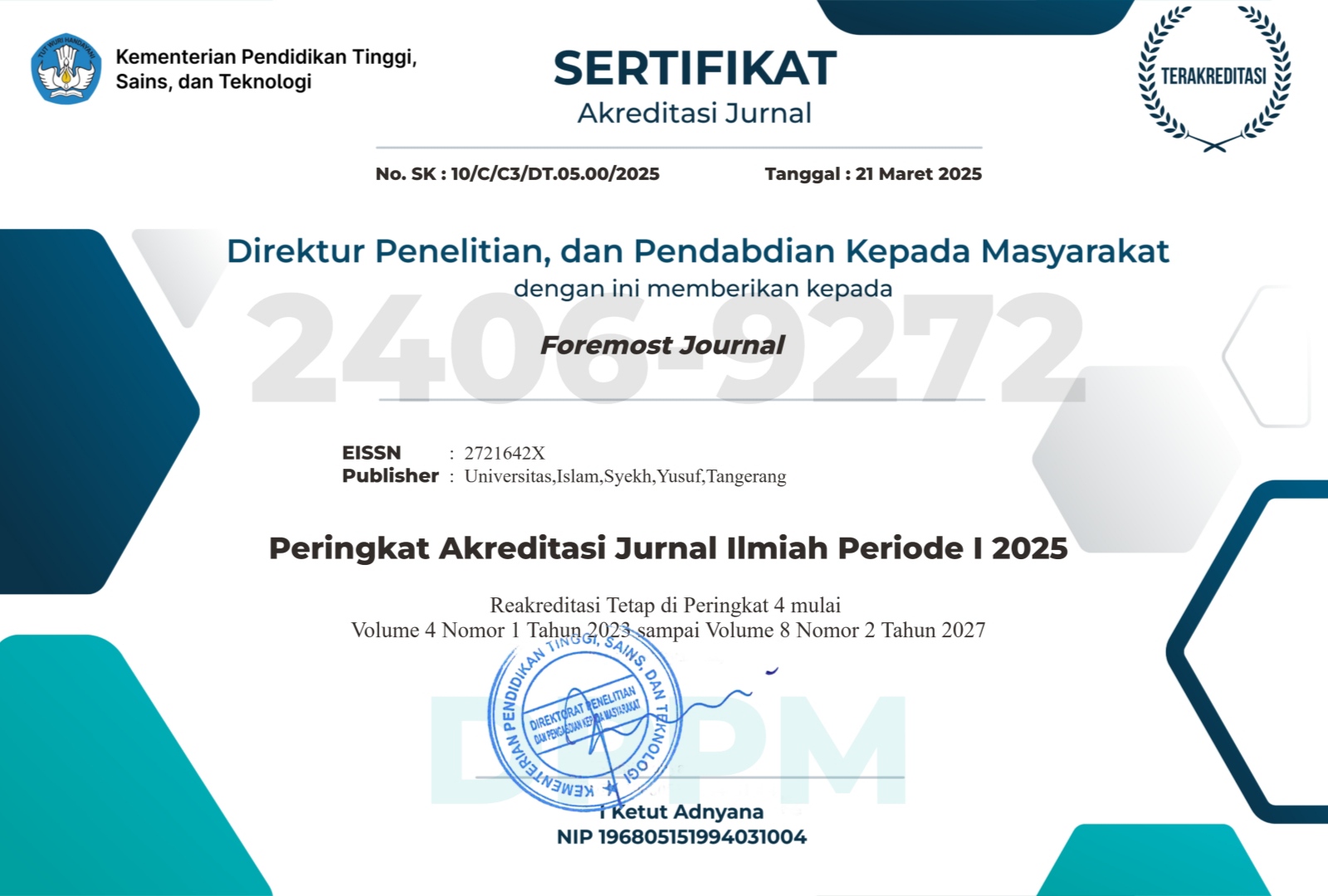
JOURNAL CERTIFICATE
REFERENCE TOOLS


Bantuan Sistem
Laporkan masalah teknis portal ejournal. Pesan dikirim ke tim support.