About the Journal
About The Journal
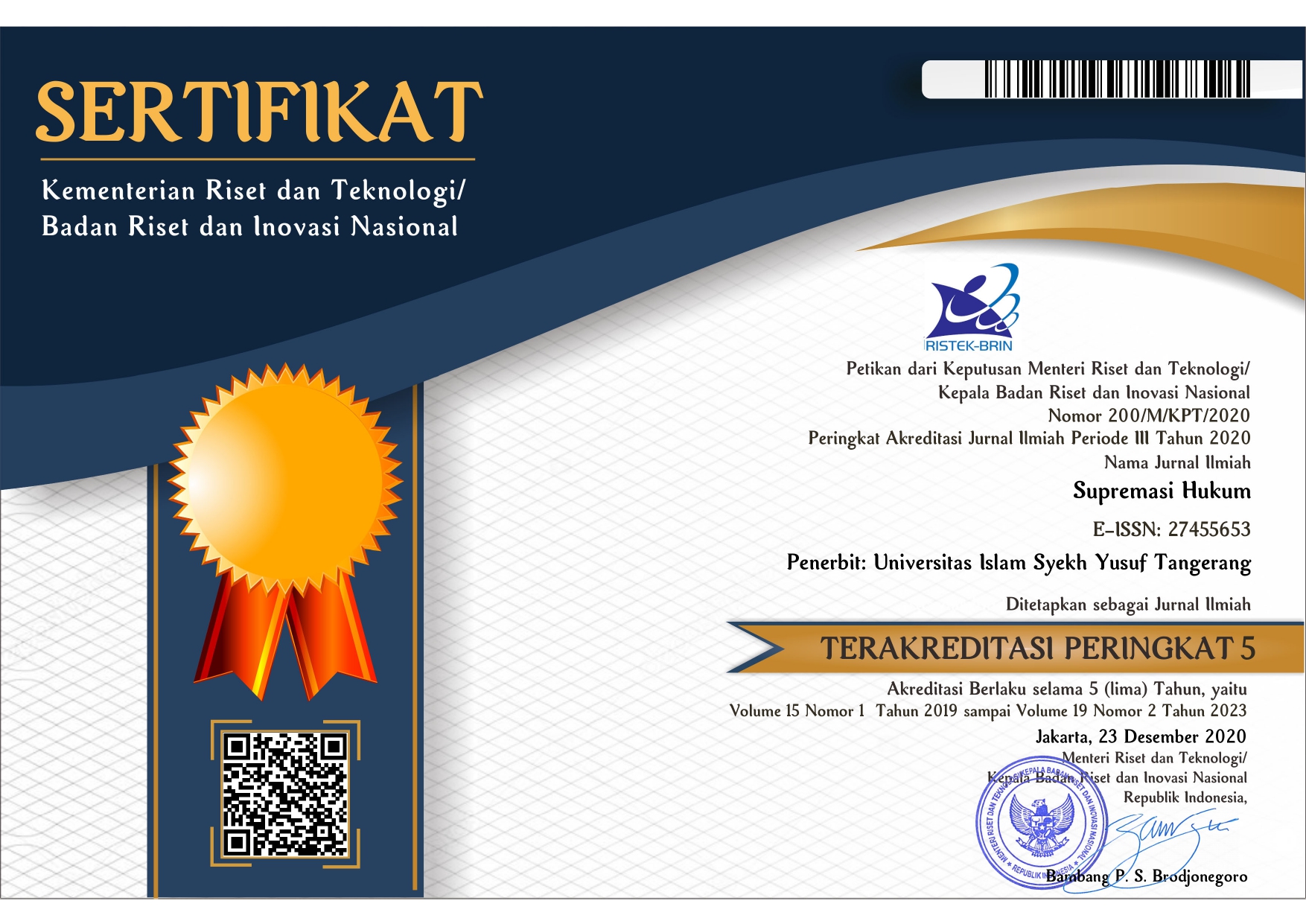
SUPREMASI HUKUM, an ISSN national journal P ISSN 02165740 ,?E ISSN 27455653? , provides a forum for publishing research result articles, articles and review books from academics, analysts, practitioners, and those interested in providing literature on Legal Studies in all aspects.
Focus and Scope
The Journal of Supremacy of Law publishes articles derived from ideas, normative and empirical research, and library discussions written in Indonesian and English. The scope of the journal of the supremacy of the law includes: criminal law and events, civil and event law, state business system and event, business and the event, justice, corporate law, guarantee law, banking law, criminal law, crime law, penitentiary law, telematics law, and so on.
Check Plagiarism
Every article submitted to the Rule of Law journal will be checked using software Turnitin
Copyright Notice
Authors who publish with Supremasi Hukum agree to the following terms:
- Authors retain copyright and grant the journal right of first publication with the work simultaneously licensed under a Creative Commons Attribution-NonCommercial-ShareAlike 4.0 International License.. that allows others to share the work with an acknowledgment of the work's authorship and initial publication in this journal.
- Authors are able to enter into separate, additional contractual arrangements for the non-exclusive distribution of the journal's published version of the work (e.g., post it to an institutional repository or publish it in a book), with an acknowledgment of its initial publication in this journal.
- Authors are permitted and encouraged to post their work online (e.g., in institutional repositories or on their website) prior to and during the submission process, as it can lead to productive exchanges, as well as earlier and greater citation of published work (See The Effect of Open Access).
Archiving Policy
This journal utilizes the LOCKSS and CLOCKSS system to create a distributed archiving system among participating libraries and permits those libraries to create permanent archives of the journal for purposes of preservation and restoration. All content in the CLOCKSS Archive and the Global LOCKSS Network is preserved with explicit publisher permission, secured via written contract or through online permission statements. We work closely with LOCKSS network implementers to facilitate development of governance and legal terms that are appropriate to the implicated content, jurisdictions, rights, and access affordances
Open Access Policy
This journal provides immediate open access to its content on the principle that making research freely available to the public supports a greater global exchange of knowledge.
This journal is open access journal which means that all content is freely available without charge to users or / institution. Users are allowed to read, download, copy, distribute, print, search, or link to full text articles in this journal without asking prior permission from the publisher or author. This is in accordance with Budapest Open Access Initiative
All articles published by the Supremasi Hukum are openly accessible on the principle that making research freely available to the public supports greater global knowledge exchange. It means:
- Every reader has free and unlimited access to the full-text of all articles published in Lebesgue Journal, and
- Every reader is free to re-use the published article if proper citation of the original publication is given.
Retraction
The articles published in Supremasi Hukum will be considered to retract in the publication if:
- They have clear evidence that the findings are unreliable, either as a result of major error (eg, miscalculation or experimental error), or as a result of fabrication (eg, of data) or falsification (eg, image manipulation)
- It constitutes plagiarism
- The findings have previously been published elsewhere without proper attribution to previous sources or disclosure to the editor, permission to republish, or justification (ie, cases of redundant publication)
- It contains material or data without authorisation for use
- Copyright has been infringed or there is some other serious legal issue (eg, libel, privacy)
- It reports unethical research
- It has been published solely on the basis of a compromised or manipulated peer review process
- The author(s) failed to disclose a major competing interest (a.k.a. conflict of interest) that, in the view of the editor, would have unduly affected interpretations of the work or recommendations by editors and peer reviewers.
The mechanism of retraction follow the Retraction Guidelines of Committee on Publication Ethics (COPE) avaiable on https://publicationethics.org/node/19896