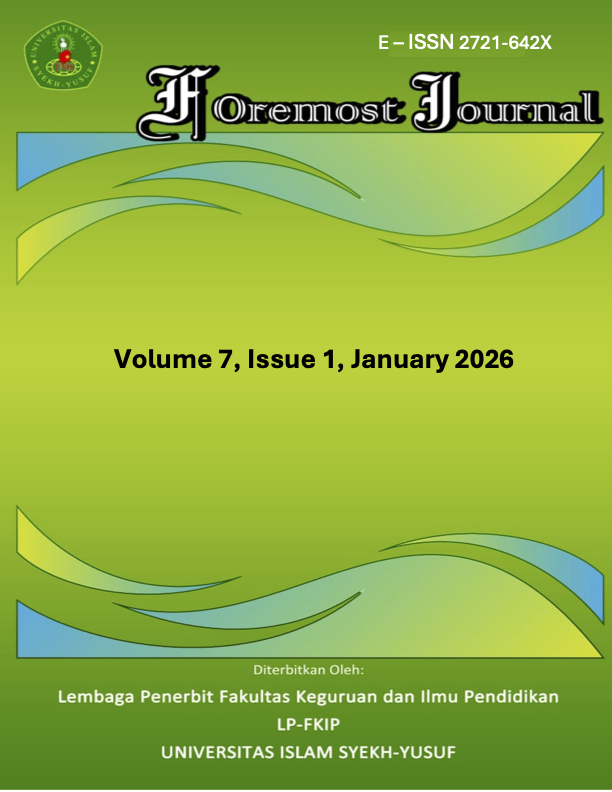
Applying Constructivist: Authentic Project-Based Learning for Increasing Performance in Writing Outcomes
DOI:
https://doi.org/10.33592/foremost.v7i1.8068Keywords:
EFL writing; constructivist learning; authentic project-based learning; writing performance; canonical correlation analysisAbstract
Writing is a complex and essential skill in English as a Foreign Language (EFL) learning that requires not only linguistic accuracy but also cognitive engagement, interaction, and reflection. This study aims to examine the relationship between constructivist writing instructional practices implemented through Authentic Project-Based Learning (A-PBL) and students? writing performance outcomes. Employing a quantitative quasi-experimental one-group pre-test?post-test design, the study involved 35 first-semester undergraduate students enrolled in a Writing course at Universitas Islam Syekh Yusuf. Data were collected through writing performance tests assessing contextual, interactive, and reflective writing, as well as a questionnaire measuring students? engagement in constructivist practices, including brainstorming, collaborative writing, peer feedback, real-world writing tasks, and instructional scaffolding. The data were analyzed using descriptive statistics, multiple regression analysis, and Canonical Correlation Analysis (CCA). The findings reveal a statistically significant multivariate relationship between constructivist learning practices and writing performance outcomes, with interactive and reflective writing emerging as the most strongly influenced dimensions. Although contextual writing did not show a direct significant effect, it functioned as a foundational component supporting higher-level writing engagement. The study concludes that constructivist-oriented writing instruction, particularly through A-PBL, effectively promotes interactive and reflective writing development and provides a theoretically grounded approach for enhancing EFL writing performance in higher education contexts.
Downloads
Published
How to Cite
Issue
Section
License
Copyright (c) 2026 Foremost Journal

This work is licensed under a Creative Commons Attribution-NonCommercial-ShareAlike 4.0 International License.
- Authors certify that the work reported here has not been published before and contains no materials the publication of which would violate any copyright or other personal or proprietary right of any person or entity.
- Authors transfer or license the copyright of publishing to Foremost Journal to publish the article in any media format, to share, to disseminate, to index, and to maximize the impact of the article in any databases.
- Authors hereby agree to transfer a copyright for publishing to Foremost Journal a Publisher of the manuscript.
- Authors reserve the following:
- all proprietary rights other than copyright such as patent rights;
- the right to use all or part of this article in future works of our own such as in books and lectures;
- use for presentation in a meeting or conference and distributing copies to attendees;
- use for internal training by author's company;
- distribution to colleagues for their research use;
- use in a subsequent compilation of the author's works;
- inclusion in a thesis or dissertation;
- reuse of portions or extracts from the article in other works (with full acknowledgement of final article);
- preparation of derivative works (other than commercial purposes) (with full acknowledgement of final article); and
- voluntary posting on open web sites operated by author or author???s institution for scholarly purposes, but it should follow the open access license of Creative Common CC BY-NC-SA License.